

Camps set record attendance last summer, Foundation for Jewish Camp census finds

Authored by Jay Deitcher for ejewishphilanthropy.com
With the cost of living rising ever higher in America, so too is the price of summer camp. Despite this, a record number of children attended camp this year, according to a new census released by the Foundation for Jewish Camp. The study found that this was, in part, made possible by $47.2 million in financial aid, allowing tens of thousands of children to attend camp who otherwise would not have been able to.
“At a time of upheaval, when there’s a lot of unknown and a lot of fear, camps are building a better world, one community and one person at a time,” Jamie Simon, CEO of Foundation for Jewish Camp, told eJewishPhilanthropy. “Camp is promoting Jewish identity, Jewish leadership and Jewish community, and that is really what people are craving. It is a safe place to be prideful and joyful about your Jewish identity.”
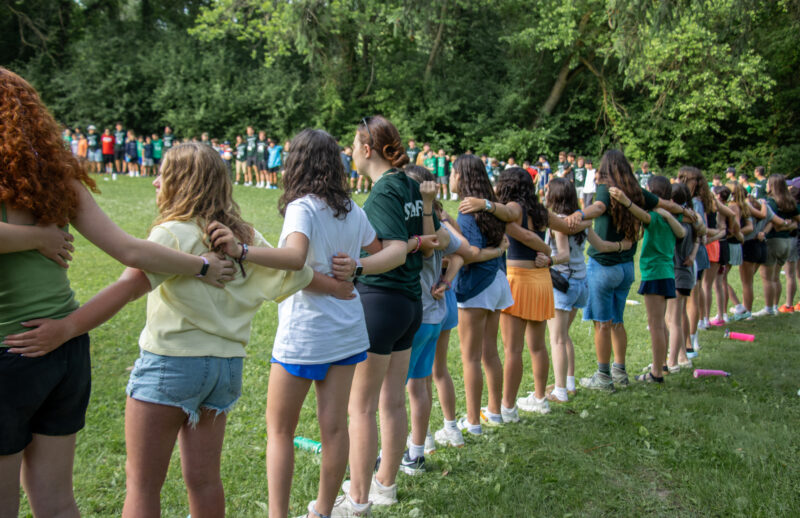
The report, titled “2025 State of the Field Census Part I: The Business of Operating Jewish Camp,” shows that attendance at FJC’s network of 168 day camps and 161 overnight camps increased 5% since last year to nearly 200,000 children and staff, setting a new all-time record, 9% over the 2019 pre-pandemic rate. The census, which was released last Thursday, focused on the business aspects of Jewish camping, with the second part of the report due to be released in February, exploring demographics, enrollment patterns, camp capacity, seasonal staff compensation and the impact of camp on campers and staff.
Rising costs remain the top concern for both overnight and day camps, with this year’s expenses increasing 5% over last year’s. Everything has ratcheted in price, including staffing, security and food. “Things are expensive, and so running a camp is no exception,” Simon said, adding that camps “worked tirelessly to keep tuition relatively stable, even as the broader economy drives up operating costs.”
Partially because of these rising costs, families requested more than $58 million in financial aid, with camps distributing $47.2 million — $33.5 million for overnight camps and $13.7 million for day camps — a more than $7 million increase from the year before. The financial aid was provided by the camps themselves, local federations, philanthropic partners and FJC. Without the assistance, 37% of families said they could not have afforded camp, according to the census.
Next year marks the twentieth anniversary of FJC’s One Happy Camper initiative, which aims to attract new campers by offering $1,500 grants for their first and second years at camp. The grants are provided regardless of need and can be paired with other forms of financial aid. Since launching, FJC has provided over 130,000 OHC grants.
With a growing number of campers, camps need to increase their capacity — adding beds, staff housing and other infrastructure. In the past five years, 53% of overnight and 21% of day camps have completed new buildings or refurbished old ones, and in the next five years, 58% of overnight and 36% of day camps hope to complete capital projects, the survey found. To stay competitive, camps are also improving their swimming pools, art centers, outdoor amphitheaters and synagogues.
Many of these projects were supported by the Gottesman Fund, which awarded $15 million last December to FJC — the largest grant it has ever received — to help the more than 300 Jewish summer camps expand their capacity and modernize their facilities. Some campgrounds have not been updated since the 1950s.
“Ensuring that these infrastructures are updated so they can exist for another 50, 100 years is really critical,” Simon said. “One camp told me that because of the Gottesman grant, [camps] are going to be able to serve 100 more kids this summer, and so in 10 years, that’s over 1000 kids.”
Even with the increased costs of running camp and with investments in improving facilities, camp revenue increased 6% over last year. One way camps are generating revenue is through off-season programming, with 65% of overnight camps and 62% of day camps offering programming across the calendar and nearly half of overnight camps and over half of day camps hoping to expand their year-round programming.
Year-round program not only allows camps to spread “the magic of camp beyond the summer,” Simon said, it also allows camps new ways to increase revenue by offering programming on weekends, breaks and after school.
The most popular year-round programming remains family camp, allowing babies and toddlers to experience camp alongside older siblings, parents and grandparents. “You can get people connected to the Jewish community from a young age and become lifelong campers,” Simon said. In addition, camps are offering bar and bat mitzvah programming, after-school programs, men and women’s retreats, young adult weekends and Israel/Palestine dialogue sessions.
Post-Oct. 7, camp remains space for hope, Simon said. “When one kid goes to Jewish camp, they are going to live a Jewish life. When hundreds of thousands of young people are going to Jewish camp, they’re building the Jewish future, and our Jewish future is bright.”
